

MAINTENANCE — SUPPORT
WEBSITE MAINTENANCE AND SUPPORT
With website maintenance services from SEOS Design, someone answers when something breaks, keeps the technology up to date and develops the website further when your offer changes. We maintain Webflow websites and coded websites with a headless CMS – including ones others have built, after a review. An hour bank or a fixed monthly plan, with no lock-in, and an agreement that states clearly what is included.
SOMEONE WHO TAKES CARE OF THE WEBSITE AFTER LAUNCH
A website is not finished when it launches. Forms stop sending, integrations stop working when another system changes its API, pages and images are added until performance drops, and your offer changes faster than the structure can keep up with. Maintenance is the work that keeps the website working, secure and up to date – and it looks different in Webflow and in a coded website with a headless CMS.
We maintain both tracks, including websites we did not build. If you are about to leave your current agency, we describe what to check before you end the agreement in the section on what you own and need to get out. This page covers what happens afterwards.
What is included
- Support
- Maintenance
- Further development
- Core Web Vitals
- Integrations
- Content and SEO
Long partnerships
maintenance and SEO in everything from finance to medtech
0 months
minimum term – for both the hour bank and the maintenance agreement
Multilingual SEO
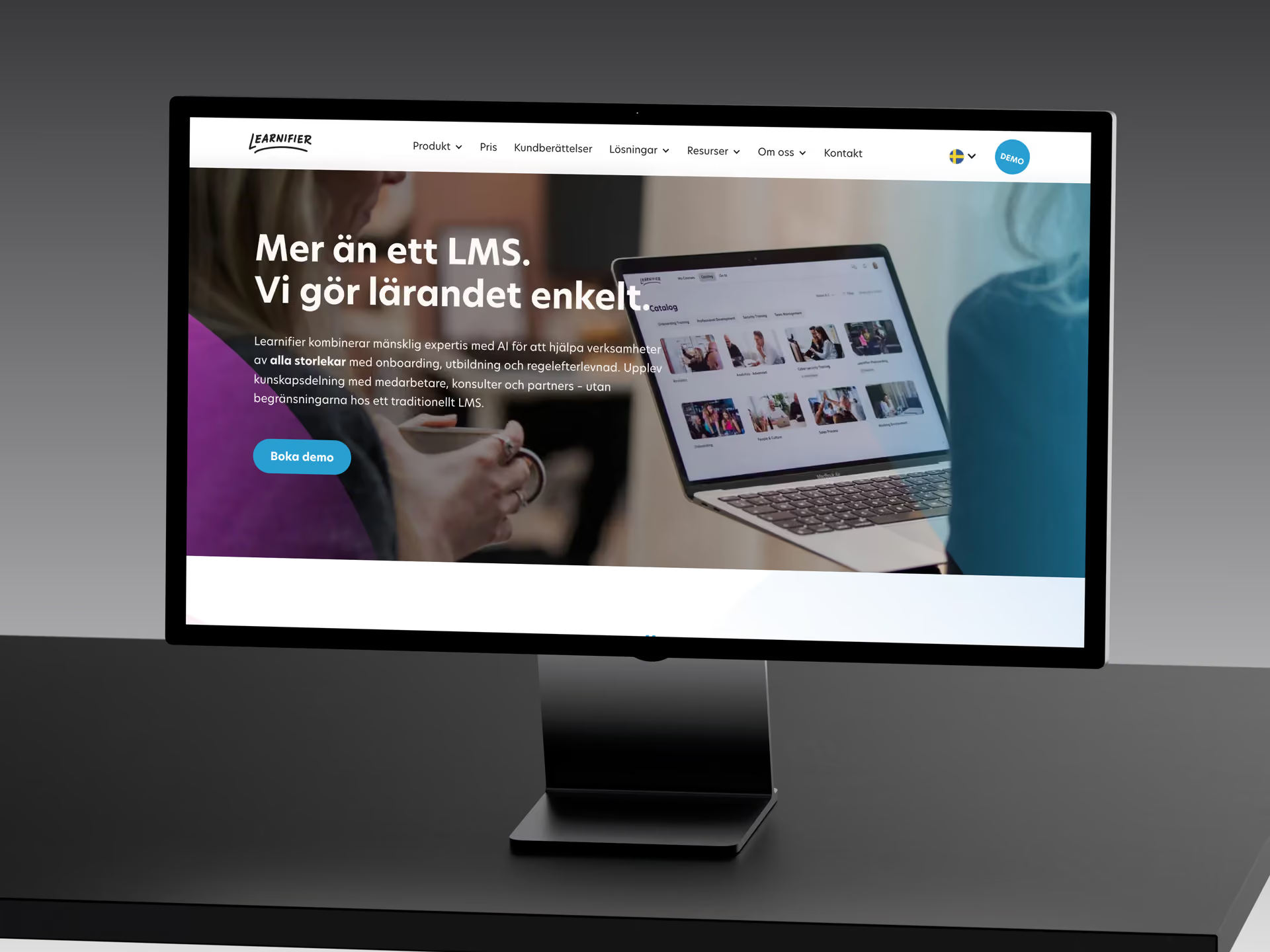
Learnifier – four markets in one CMS, better rankings and deals that started in AI assistants
Our process
FROM REVIEW TO ONGOING MAINTENANCE
SEOS Design's ability to turn our ideas into a modern, fast and high-converting website has made a real difference. Their ongoing SEO and AEO work has also been invaluable for our organic visibility and traffic.
 Isabelle SchoriHead of Marketing, LearnifierTranslated from Swedish
Review of the website
We go through ownership and access, how the website is built and what technical condition it is in: performance, indexing, forms, integrations and security. If someone else built the website, we only take it over after this step. You get a written recommendation.
Set-up and agreement
Based on the review, we propose an hour bank or a maintenance agreement at a fixed level, and we write down what is included, what falls outside and which response times apply. Accounts in someone else's name are moved to yours before the work starts.
Ongoing support and maintenance
You get in touch when something breaks or you are stuck. On the coded track, we keep code, dependencies and performance up to date, and on both tracks we monitor Core Web Vitals. Urgent outages take priority over planned work.
Check-ins and further development
At regular intervals, we review what has changed in the business and what the website needs to keep up – new sections, integrations or structural changes. The work is planned into the agreement's development time – using AI where it speeds things up, so more fits into the hours – or quoted as a project when it is bigger.
What do maintenance and support cost?
Maintenance agreement from around SEK 5,000 (≈ €450) a month · hour bank: fixed price after a call
We offer maintenance in two forms. An hour bank for support and smaller changes: you buy a number of hours, use them when something needs doing and top up when they run out. It suits Webflow and other websites that need little maintenance, and we give you a fixed price after a call. The other form is a maintenance agreement at a fixed monthly level, covering maintenance of code and dependencies plus a set amount of development time. It suits a coded website with a headless CMS when you do not have your own developer, and in our experience a meaningful level starts at around SEK 5,000 (≈ €450) a month. The level depends on how much you plan to change the website, not on its size.
Neither form has a lock-in – we should earn the right to continue every month, and you should be able to end the arrangement without the website being affected, because the accounts, code and content are already yours. Maintenance is part of what a website costs to own over time, not just to build. To compare both tracks, see the price ranges and the calculator for what a website costs to build and own. We quote for maintenance after the review.
Selected projects


Common questions about maintenance and support
Can you take over a website someone else built?
Yes, after a review. We take over maintenance of websites that other agencies, freelancers or an in-house team have built – in Webflow or as a coded website with a headless CMS. The review answers three questions: do you own what you think you own, can the build be maintained as it is, and what needs fixing before we take responsibility for it. The result is a written recommendation that you can act on with us or with someone else.
- Ownership and access: Webflow account or code repository, who is registered as the domain holder, hosting and DNS accounts, analytics and Search Console accounts. Whatever is in the agency's name is moved to yours before we start.
- The build: in Webflow, class structure, component library and CMS model; in code, quality, versions, dependencies and documentation. This is what decides whether the website can be maintained at a reasonable cost.
- SEO and operational status: indexing, redirects, Core Web Vitals, whether forms and integrations actually work, and known security gaps.
The recommendation ends in one of three outcomes: we take over the website as it is, we take it over after a number of fixes quoted separately, or we recommend a rebuild or a move. We only recommend a rebuild or a move when the cost of maintaining the existing build cannot be justified – a rebuild is a project in its own right and should be quoted as one, not as part of switching agency. In most cases, we take over Webflow and coded websites. We take over WordPress and WooCommerce websites only in niche cases, when the build is solid and the reliance on plugins is limited. More often we recommend a move; the Webflow vs WordPress comparison shows the differences in running and maintenance, and the step-by-step guide to migration shows how the move is done.
How quickly do we get help when something is broken?
Response times are set out in the agreement, and they differ between the hour bank and the maintenance agreement. Urgent outages – the website down, forms not sending, an integration that has stopped working – always take priority over planned work. We do not promise response times on a sales call that are not written into the agreement, so that you can compare us with other suppliers on equal terms.
What does website maintenance involve – and what can be included?
Website maintenance is the ongoing work that keeps a website working, secure and up to date after launch. The term covers three things that are often mixed up in quotes:
- Support is reactive – someone to contact when something has broken or when you are stuck in a tool. Usually paid by the hour.
- Maintenance is proactive – updates to code and dependencies, security, backup and performance monitoring. It is done whether or not you have ordered anything that month.
- Further development is planned – new sections, integrations and structural changes when the business changes. Bought from the hour bank, as a project or as a fixed amount of time per month.
A proactive maintenance agreement can also include content and SEO – copy, SEO and ongoing improvements, as much as you want. You should always be able to publish yourselves.
On Webflow, most clients only need support and further development. A coded website needs all three, and maintenance is the reason an agreement is often worth having. Exactly what your set-up includes is stated in the agreement.
What help do we get with Webflow – when something lies outside the editor?
You rarely need help to publish in Webflow – the marketing team does that itself. The need arises when something falls outside the editor: a page that looks wrong after a change in the Designer, a form that has stopped sending, an integration that broke when a third-party system changed its API, a section type missing from the component library, or performance that has dropped after a year of new pages and images.
Webflow is a hosted platform: hosting, SSL and platform updates are handled by Webflow, and there are no server-side plugins to keep updated. So the maintenance side is small, and you do not need an agreement with us for Webflow maintenance. Support is bought as an hour bank and used when needed. We support Webflow websites whoever built them. If you instead need a website built from scratch or from your finished design, or moved from another platform, see the page about our Webflow agency.
When is a maintenance agreement for a coded website with a headless CMS worth it?
A coded website with a headless CMS needs a developer for everything outside the content. You manage copy, images and new pages of existing types yourselves in the CMS – Sanity, Contentful or Storyblok. New page types, new fields in the content model, integrations and changes to how pages are rendered are done in code. If you have your own developer, they can take over completely. If you do not, a smaller maintenance agreement is often a good idea, so that help is close at hand when you need it.
The code also has dependencies. Frameworks such as Next.js and Astro, packages and the hosting platform are updated constantly, and security updates are released without warning. Without someone looking after the code, the website gradually becomes harder to build on – the same technical debt WordPress accumulates through plugins, only in your own code. So maintenance should be ongoing, whether by your own developer or by us.
Our maintenance agreements for coded websites always cover four things: updating frameworks and dependencies, monitoring the website's operation and performance, priority support when something fails, and a fixed amount of development time each month. We adjust the level when the pace changes. That cost – build price plus ongoing maintenance – is part of the platform decision, and we calculate it before you choose a track. How we build on the coded track is described on the page about our headless CMS agency.
Do we need an agreement if the website is in Webflow?
No. Webflow handles hosting, SSL and platform updates, and you publish and build new pages yourselves in the editor. What you need is support when something falls outside the editor, and that is bought as an hour bank when needed. If you want a dedicated contact who knows the build and monitors performance every month, that can be arranged as an ongoing set-up – but it is a choice, not a requirement.
What costs come on top of your maintenance fee?
Hosting, domain and any licences. Webflow hosting is paid to Webflow, hosting for coded websites to Vercel or the provider you have chosen, and a headless CMS such as Sanity or Contentful has its own pricing plans. Everything is registered in your name and invoiced directly by the provider – nothing goes through us. Larger development work that does not fit into the agreement's development time is quoted as a separate project, so that you know the cost before the work starts.
Do you handle hosting, domain and email?
We do not sell hosting or run any servers of our own, but we set everything up in your name. We recommend the provider that suits the platform – Webflow's own hosting for Webflow websites, Vercel for coded ones – so that you pay the provider directly and own the account. The reason is lock-in: an agency that owns your hosting has a built-in reason for you to stay, whereas with your own accounts you only need to change who has access. Modern hosting is also no longer a server that needs looking after; Webflow and Vercel have CDN, SSL and publishing built in. If you need hosting in Sweden or the EU for regulatory reasons, that is an argument for the coded track, where you can choose hosting freely.
The domain is registered at a domain provider with you as the holder, and we set up the DNS. We recommend keeping email with a separate provider, independent of the hosting, so that the website can be moved without affecting email.
WHO TAKES CARE OF THE WEBSITE AFTER LAUNCH?
Book a free call. We look at your website, who owns what today and what maintenance it needs. If support when something breaks is enough, we will recommend an hour bank rather than an agreement. If you already know what you want, you can request a quote directly.