

SANITY AGENCY FOR STRUCTURED CONTENT
SEOS Design is a Stockholm-based Sanity agency that builds coded websites with Sanity as the headless CMS and Next.js or Astro as the frontend. The content is modelled as code, edited in a Studio tailored to your team, and can be reused across other channels. The set-up is very well suited to efficient, AI-assisted further development – by us or by you – and suits companies that want to own their data model.
What is included
- Sanity implementation
- Headless CMS
- CMS migration
- Web apps
- Technical SEO
- Maintenance
4–6 weeks
normal project time from brief to launched website
0 months
lock-in period on the maintenance agreement – cancel whenever you like
Fixed price
after a free call
Sanity development in brief
- Suits companies that want to own their data model and use the same content on the website, in an app or in other channels.
- You get schema as code in TypeScript, a Sanity Studio adapted to your team and a frontend in Next.js or Astro with a solid technical SEO foundation from the start.
- We build new websites, migrate from platforms such as WordPress and Contentful, and take over Sanity websites that someone else has built.
- If you have your own developer, you can take over completely after launch. Otherwise a smaller maintenance agreement is often a good idea – without a lock-in period.
- A data model and frontend as code make the website easy to develop further with AI assistance – new page types, languages and integrations without starting over.
FROM DATA MODEL TO A WEBSITE YOU GROW WITH
Sanity is the headless CMS we most often recommend in the coded track of our web development. The content lives in Sanity, the website is built as a separate frontend in Next.js or Astro – and because both the data model and the frontend are code, the website can be developed further efficiently and with AI assistance, by us or by you.
What decides the result is not the design but the model: how services, people, case studies, languages and pages fit together. We define it in code before anything is built, tailor Sanity Studio to how your team actually works and build the frontend with SEO and AEO on the same structure. After launch you can take over completely if you have your own developer – otherwise we can carry on maintaining it.
FROM MODEL TO A WEBSITE THAT SCALES
We weren't looking for an agency that would just deliver a website – we were looking for a digital partner. SEOS Design built the website, set the tone of voice and now runs all of our SEM work. Having everything in one place, with a skilled and innovative team that owns the whole picture, has made an enormous difference to pace and quality. We couldn't be happier!
 Emil GlenngårdFounder, TillväxtstödTranslated from Swedish
Needs, channels and choice of platform
We map what the website has to do, which channels and systems the content needs to reach and who will publish. Only then do we confirm that Sanity is the right track – or recommend Webflow if being able to change the layout yourselves matters most.
Data model and Studio
Document types, fields, relations and languages are defined as schema in TypeScript and reviewed with you before anything is built. In parallel, Sanity Studio is configured: preview, validations and roles that match how your team works.
Frontend and content migration
We build the frontend in Next.js or Astro with technical SEO and performance measured against Core Web Vitals. In a migration, the content is moved with scripts and every old URL gets a 301 redirect.
Launch, training and handover
We help you point the domain and deploy, and hand over the code and the Sanity project in your name. If you want, we set up tracking and train your team in the Studio. If you have your own developer you can take over completely; otherwise, you can sign an ongoing agreement with us for maintenance, further development and SEO if you wish – with no lock-in period, of course.
What does a website with Sanity cost?
fixed price before we start
The price is set by what your website actually needs. Below you will find price indications and examples of websites at each level.
The price is driven by how much strategy and structure has to be developed before the build, the scope of the data model – number of document types and relations – how much the Studio needs customising, the scope of the frontend, multiple languages, integrations, whether content needs migrating and how much you want to invest in SEO. If you want to run the numbers yourselves first, use the calculator for what a website costs to build and own.
Three costs sit outside the build and should be included from the start: the Sanity licence (Sanity has a free tier and paid plans – we go through which one you need), hosting with Vercel or equivalent, and any maintenance agreement with us, without a lock-in period. So compare Sanity and Webflow on the cost in year 1 and year 3, not just on the build price – that is how we set up the quote.
Always included – whatever the level
Every website we build, whatever the price, is built on strategy, has a custom design and meets the same technical standard.
- Strategy before design
- Custom design
- Always a solid SEO foundation
- You own the account, the code and the content
01
Landing page or small website
SEK 25,000–45,000 (≈ €2,200–4,000)
A landing page, a campaign page or a small website where the brand identity and copy already exist.
SEK 25,000–45,000 (≈ €2,200–4,000)
Landing page or small website
Examples that tend to land here
- A landing page for a campaign or a service.
- A small website on your existing visual identity, with your own copy and images.
02
Website on an existing strategic foundation
SEK 50,000–85,000 (≈ €4,500–7,600)
A complete website when the logo, direction and message are there to build on.
SEK 50,000–85,000 (≈ €4,500–7,600)
Website on an existing strategic foundation
Examples that tend to land here
- A normal-sized website with a blog or case studies: page structure, custom design, build and an SEO and AEO foundation.
- A small website where we start from scratch – message, structure and material developed together with you.
03
Website with strategy and content
SEK 90,000–135,000 (≈ €8,000–12,000)
When the message, the copy or an SEO effort needs to be done before the build.
SEK 90,000–135,000 (≈ €8,000–12,000)
Website with strategy and content
Examples that tend to land here
- A mid-sized website with strong branding, plus a one-off SEO effort: keyword research, page structure and copy.
- A website where the message and tone of voice are developed in a workshop with several stakeholders on your side, before anything is designed.
04
Larger or more complex website
From SEK 140,000 (≈ €12,500)
Large websites, several languages, custom integrations or a rebuild where the search visibility has to come along.
From SEK 140,000 (≈ €12,500)
Larger or more complex website
Examples that tend to land here
- A rebuild of a larger website that ranks: URL mapping, redirects and a new search strategy.
- A multilingual website, or integrations with your own systems.
Every level can include strategy, copy, SEO and migration. A small website where we start from scratch can cost more than a larger one where the groundwork exists – it is the scope that decides, not the size. Prices exclude VAT; the euro figures are approximate.
What affects the price of a website?
Ten things, and all of them can be answered in a first call.
- The starting point – do the logo, message and copy exist – or are we starting from scratch?
- Strategy – how much help you need with positioning, message and structure before anything is designed.
- Number of page templates – not the number of pages. Five pages on one template is less work than five templates.
- Copy – how much we write, compared with what you supply.
- Design – following your existing identity, or developing it – and whether images, illustrations or animations need to be produced.
- SEO and AEO – the technical foundation is always included. An SEO effort with keyword research, SEO copy and schema markup is an add-on you choose.
- Languages – one, or several from the start.
- Integrations – with a CRM, a booking system or your own systems.
- Migration – twenty URLs to move, or a hundred and sixty.
- Build track – Webflow or a coded website with a headless CMS.
Describe what you need in an enquiry, or book a first call with us – we will get back to you quickly with a fixed price, before anything is built.
Your own team can run the website easily, by hand in the CMS or with AI. If you want ongoing help, we are there, with no lock-in period.
Selected projects

Common questions about Sanity development
When is Sanity the right choice – and when are Webflow or Contentful a better fit?
Sanity is often a good fit when the content will be used in more places than the website, when you want to own your data model and when several editors or languages need to be handled in the same system. Webflow is often a good fit when the marketing department needs to build new pages and change the layout entirely on its own, without developers. Contentful tends to make more sense when the organisation has already chosen it as a standard or wants a ready-made editing environment rather than a customised one. The choice is yours – we make a recommendation once we know more about your needs.
The difference from Webflow is not quality but division of labour. In Webflow, design, content and hosting sit in one system that the editor controls. With Sanity the content sits in a headless CMS and the website is a coded frontend in Next.js or Astro – the editor owns the content, the developer owns the structure. That gives more control and freer integrations, but someone has to know the code when the structure needs changing. We usually recommend Sanity in three typical situations:
- The content has to go out to several channels – website, app, partner portal or an internal tool – from a single source.
- The website has to pull data from your own systems: product registers, business systems, CRM systems such as HubSpot or Salesforce, or a booking system.
- You have an editorial team, several languages or several brands that need to work in the same model without getting in each other's way.
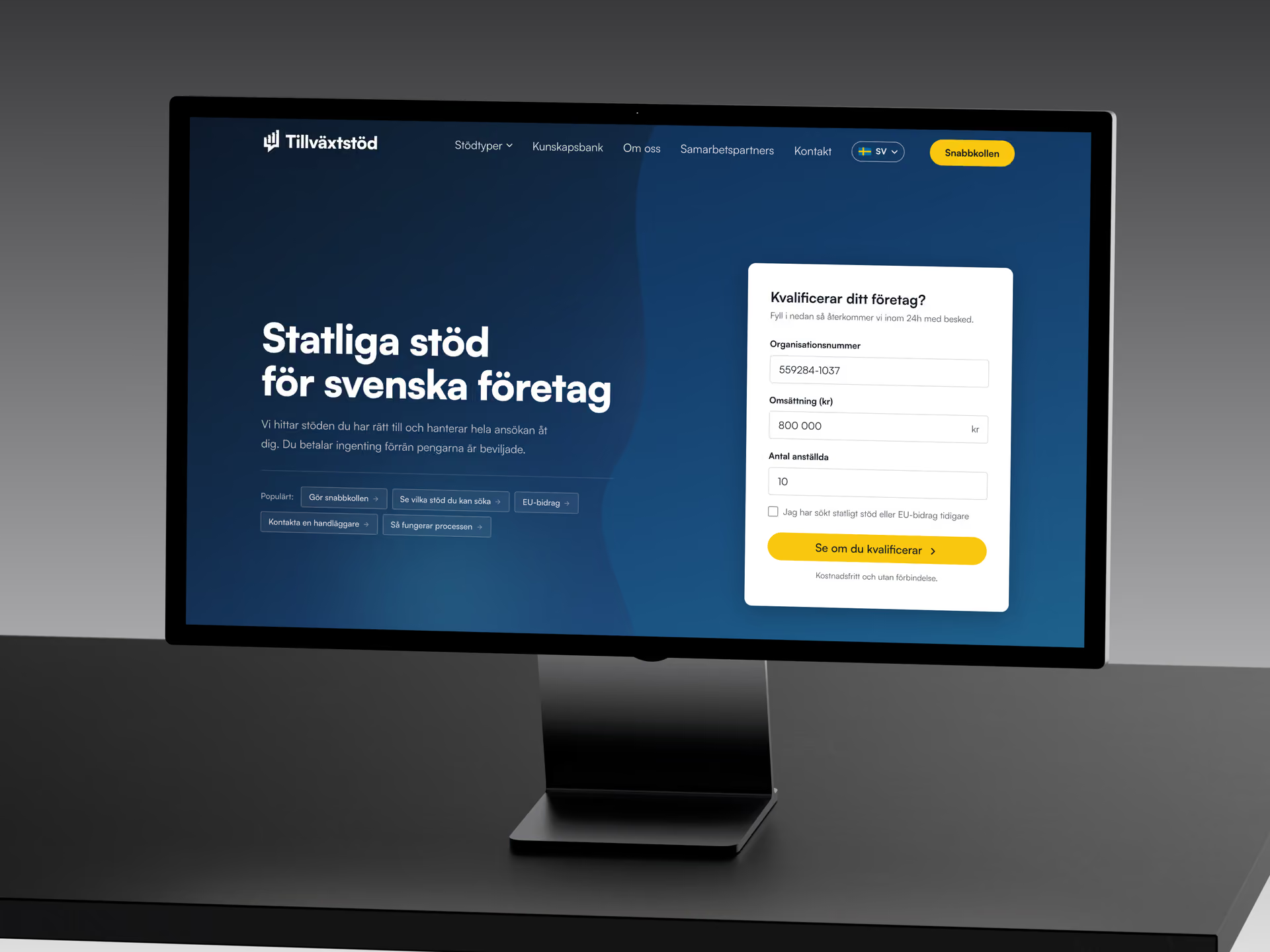
If any of these applies, Sanity is a good track. That is how we built for Tillväxtstöd – Next.js and Sanity with a multi-step form connected to Salesforce – and for SeaPattern, a coded Sanity website in Swedish, English and German. If none of them applies, Webflow is often the cheaper choice over time. We describe how we weigh Sanity, Contentful, Storyblok and Webflow against each other on the headless CMS agency page. If you are coming from WordPress or Contentful, the content is moved with scripts and every old URL gets a 301 redirect – the method is in the step-by-step guide to migration.
Sanity, Contentful or Storyblok – which should we choose?
As a rule of thumb: Sanity is often a good fit when you want to own the schema as code and have an editing interface tailored to your team. Contentful is often a good fit when the organisation wants a ready-made, standardised environment and already has processes around it. Storyblok is often a good fit when visual editing of whole pages is what the editors value most. You can build good websites with all three, and the choice is yours – send us your current website address and your requirements for channels, languages and integrations, and we will give you a concrete recommendation.
Can a marketing department run Sanity Studio without developers?
Before the Studio is built, we define the content model as schema in TypeScript: how services, people, case studies, languages and pages fit together. The model is version-controlled together with the website and is the project's most important deliverable – it decides what becomes cheap to build later, such as multiple languages, investor pages or careers pages.
Sanity Studio is the editing interface, and it is built around your team rather than the other way round. The goal is for a small marketing team to run all the content itself: create pages of the existing types, publish, swap images and update copy – without opening a ticket with us. We build in the things that would otherwise turn into support requests: a preview that shows the page while the editor writes, validations that stop a title tag that is too long, missing alt text or a meta description outside a reasonable length, and roles that control who can publish.
The boundary is clear: the editor creates content of the types that exist. New page types, new fields and new layouts require a developer. That is why we spend time getting the model right from the start – the more situations the model covers, the less often you need us. What sets platforms apart when the volume of content grows is covered in the guide to website platforms for growing companies.
Can we edit the website ourselves without developers?
Yes, all the content. You create pages of the existing types, write, publish, swap images and see the result in a preview directly in Sanity Studio – without knowing code. What needs a developer is new page types, new fields and changes to the layout. That is why we model broadly from the start, so that those situations are few – and we help with the rest when needed.
How does it work when you take over an existing Sanity website?
If you already have a website with Sanity – built in-house, by a freelancer or by another agency – we take it over after a review. You do not need to rebuild to change developer. A Sanity project is code and content that can be read, understood and built on.
We need access to the Sanity project, the code repository and the hosting account. The review covers schema and Studio configuration, GROQ queries and frontend code, hosting, environments and who has access to what. The result is a written recommendation: build on it, fix certain parts first or rebuild. You can take it forward with us – with ongoing maintenance without a lock-in period – or with someone else. The same review also works as a standalone piece of advice before you choose a platform or settle a data model you are unsure about – without committing to a project.
What does maintenance of a Sanity website include – and when is an agreement right?
Structural changes in a coded website are made in code, and Next.js, Astro and Sanity's packages are updated continuously. If you have your own developer you can take over completely – the code and the Sanity project are yours. If your team has no developer, a maintenance agreement with us is often a good idea, so that help is close at hand when it is needed: without someone looking after the code, the website gradually becomes harder to build on.
What you get is a developer who knows your model: dependency and security updates, new document types and fields when your offering changes, performance monitoring against Core Web Vitals, integrations and support when something looks wrong. The agreement runs without a lock-in period. For Tillväxtstöd, the partnership continued after the Next.js and Sanity launch with maintenance, further development and ongoing SEM work – an example of how a headless build can be taken further when the team does not have its own developer.
Do we need a developer on an ongoing basis if we choose Sanity?
Yes, in some form – that is the honest difference from Webflow. Frameworks and packages are updated continuously, and new page types, fields and integrations are built in code. It does not have to be an employee: a smaller maintenance agreement with us covers updates, security, performance and further development – and because the data model and the frontend are code, further development is fast and AI-assisted. If you have your own developer, we can provide support in the background instead.
What does a website built with Sanity cost?
It depends on how much strategy and structure has to be developed before the build, how many document types the model needs, how much the Studio needs customising, whether content needs migrating, whether the website will be multilingual or integrated with your systems – and how much you want to invest in SEO. We give a fixed price after a call. Include the Sanity licence, hosting and any maintenance agreement with us in the total cost – work it out yourselves in the calculator for what a website costs to build and own.
What does the Sanity licence cost?
Sanity has a free tier and paid plans. Which one you need depends on how many people will work in the Studio, which features you need – for example roles and preview – and how much content and traffic the website handles. Many smaller companies manage on the free tier for a long time. We go through which plan makes sense for you before you order, and the licence is paid directly to Sanity.
SHOULD THE WEBSITE BE BUILT ON SANITY?
Book a free call, or request a quote directly. We look at how your content fits together today, which channels and systems it needs to reach – and whether Sanity, Webflow or another headless CMS is the right track for you.