

STRATEGY — WEB & DIGITAL
DIGITAL STRATEGY THAT WINS BUSINESS
SEOS Design is a digital strategy agency. We draw on the knowledge that already exists in your company – in management, among your salespeople and in the people who deal with customers – and turn it into a strategy for the website, channels and content that should drive the business. We are happy to handle the execution, entirely or alongside your team, but you can also run the plan yourselves. The measurement plan is set before the first activity, the plan normally covers 90 days at a time, and there is no lock-in period.
THE STRATEGY – AND THE TEAM THAT CARRIES IT OUT
A digital strategy should answer three questions: which buyers you want to win, where they look, and what the website has to do to get them to make contact. The answers often already exist in the company – among your salespeople, in customer conversations and in the data you have – but are rarely brought together. We bring them together in a strategy workshop and turn them into a prioritised plan with measurement points.
Then you choose how the plan is carried out. We are happy to run it – as your outsourced marketing department or as an extension of your own team. We describe how that works in practice on the scalable marketing page. If you would rather carry out the plan with your own resources, that works just as well.
The guide to digital strategy covers what a digital strategy is, how to prioritise channels on a limited budget and the mistakes that keep coming up.
What is included
- Strategy workshop
- Measurement plan
- 90-day plan
- Channel priorities and exclusions
- Brief for a new build
- Execution as needed
1 team
plans and delivers – the same people write the plan and do the work
90 days
typical planning horizon – then the plan is updated based on what worked
0 months
lock-in period in the ongoing partnership
Our process
FROM BUSINESS GOALS TO A PLAN THAT GETS DONE
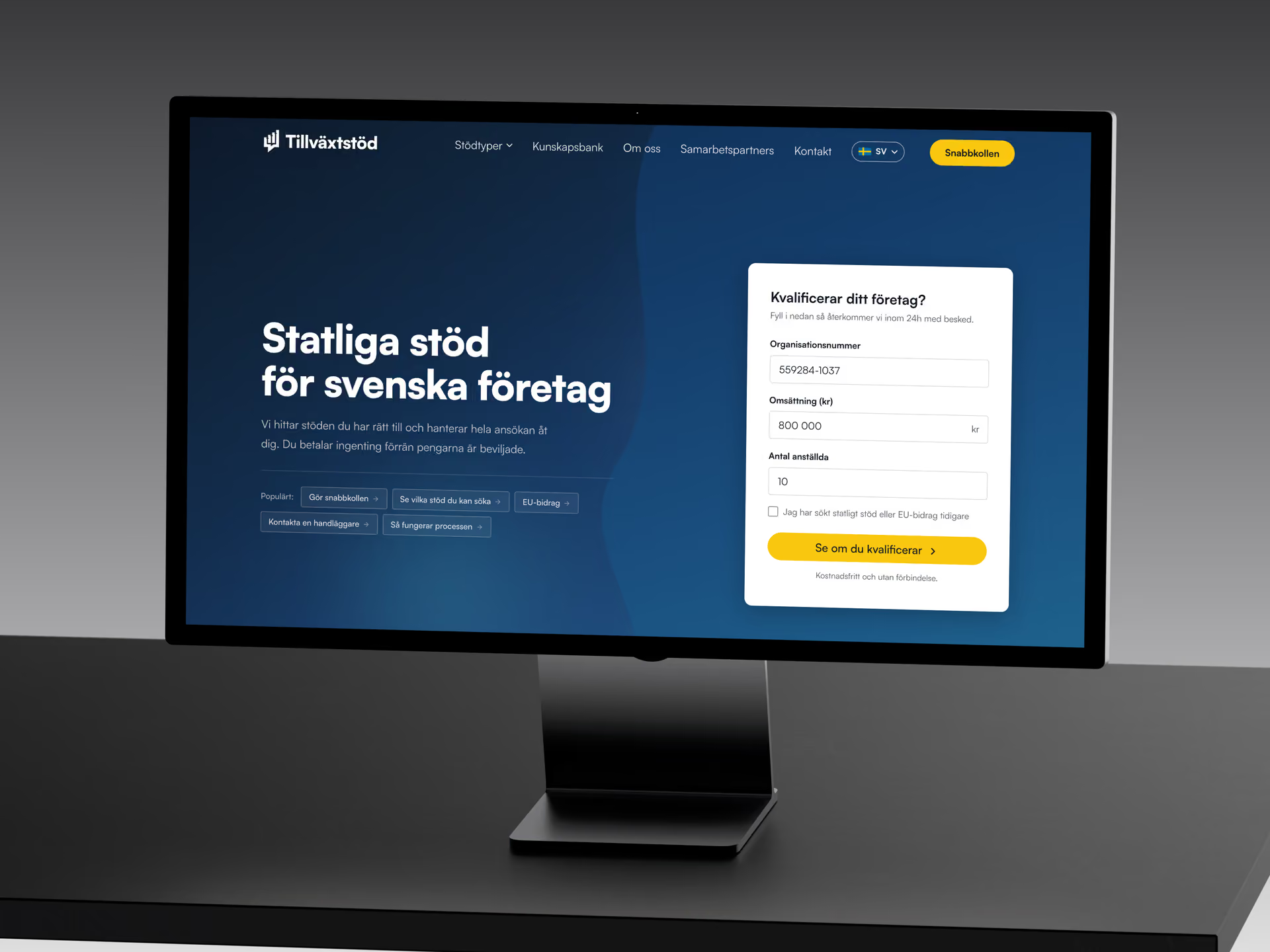
We weren't looking for an agency that would just deliver a website – we were looking for a digital partner. SEOS Design built the website, set the tone of voice and now runs all of our SEM work. Having everything in one place, with a skilled and innovative team that owns the whole picture, has made an enormous difference to pace and quality. We couldn't be happier!
 Emil GlenngårdFounder, TillväxtstödTranslated from Swedish
Discovery call and business goals
We go through the business, the target audience, your current website and channels, and what actually needs to grow: leads, sales opportunities, bookings. This is also where we decide whether strategy work is the right investment right now, or whether something else should come first.
Strategy workshop
A half-day session with you where we prioritise: which buyers, which searches and questions, which channels – and which ones we agree to rule out. It draws on search data, your sales conversations and a review of the website's structure and conversion paths.
Measurement plan and 90-day plan
You get a plan for your approval: three to five prioritised initiatives, each with one owner and one measurement point. The measurement plan comes first – what counts as a lead, which source it came from and where it is logged.
Execution and quarterly review
We build, write, optimise and advertise in line with the plan – entirely or together with your team, using AI where it speeds things up and with a specialist who keeps control of direction and quality – and we check in regularly. When we are part of the execution, we review every quarter what worked, what to stop and what to prioritise next. If you run the plan yourselves, we can review progress with you if you wish – or the plan can be a one-off piece of work that points you in the right direction. No lock-in period.
What does strategy work with us cost?
Fixed price after a call
The strategy workshop and plan come at a fixed price, which we give you after an enquiry or a free call. The price depends on the scope: how many channels need assessing, whether the website needs replanning from the ground up and how much material already exists. You know what is included before the work starts.
Execution – website, SEO, AEO, advertising, content – is priced per initiative or as an ongoing partnership with no lock-in period. The work follows the plan and is reprioritised around what works. The guide to digital strategy covers what strategy work usually costs in Sweden, and how the price differs between a focused approach and a larger project.
Selected projects


Common questions about strategy work with us
What does a digital strategy from you include?
A strategy workshop, a prioritised plan – usually for the next 90 days – and a measurement plan. The plan sets out which buyers and searches you should be visible for, which channels to prioritise and which to rule out, the structure and conversion paths the website needs, and an owner and measurement point for each initiative. If the website is going to be rebuilt, a brief for the build is included: page structure, content types and choice of platform.
How do you get from business goals to a choice of channels – website, SEO, AEO, Google Ads or content?
The choice of channels follows from where your buyers look and how quickly you need results, and we rarely recommend more than two or three channels in the first plan. The website is assessed first: if it cannot receive and convert visitors, every other channel loses impact. SEO builds an asset that keeps delivering traffic, but its progress is measured in quarters. Google Ads delivers measurable results within weeks and stops the day the budget runs out – the right choice when you need leads now. AEO is about making sure ChatGPT, Gemini and AI Overviews describe your offer correctly when a buyer asks. Content such as guides and a knowledge base works when you can keep up the pace over time – with us or on your own.
Strategic SEO here means that search work has its own place in the plan – which searches you should be visible for, and in what order – rather than being run on the side. We describe how to build such a plan step by step in the seven steps of an SEO strategy.
Just as important is what we say no to: social channels you cannot keep up with every week, a podcast before the website converts, a new website when the existing one only needs a different structure, and ads on searches that bring traffic but not business. What we rule out goes into the plan with the reasons, so it can be reconsidered next quarter. If you do not have time for social channels, we can handle the organic posts for you – read more on the social media page.
Why does the measurement plan come before any activity – what counts as a lead, which source and where is it logged?
Before any activity starts, we agree with you on what counts as a lead, which sources need to be told apart and where each lead is logged. Without that agreement, the strategy cannot be evaluated – and if it cannot be evaluated, it cannot be corrected either.
Three questions are enough. What is a lead – a booked meeting, a quote request, a demo? Newsletter sign-ups and downloads only count if you can show that they lead somewhere. Which sources should be kept apart – organic search, advertising, AI answers, direct and referral? And where is it logged – in your CRM, for example HubSpot or Salesforce, in a form field or in a spreadsheet that someone actually owns?
In practice, the measurement plan means setting up conversion events in your analytics and advertising tools, tracking selected keywords in search data and adding two fields to every incoming lead: the first known landing page and the source the customer gives. The last field is often the most revealing, because much of a B2B deal never leaves a trace in the analytics tools. The B2B SEO agency page explains why attribution breaks down in long sales cycles, and how we report anyway.
The measurement plan also sets out in advance what will make an initiative scale up, change course or stop. That turns the quarterly review into a decision rather than a discussion.
What brief do we get before a new build or a redesign – page structure, content types, conversion paths and platform?
If the website is to be rebuilt or built from scratch, we produce a concrete brief for the build: which pages the website should have and why, which content types should be produced on an ongoing basis, which routes visitors should take to get in touch, and which platform fits. The brief comes before the design, not after. The guide to website strategy explains what a website strategy really is, and why design alone is not enough.
The page structure is based on two sources: keyword research weighted towards purchase intent, and the questions your salespeople get every week. The result is an information architecture where every page has a purpose and a search or question to answer. The content types – service pages, case studies, comparisons, knowledge base – each get an owner and a publishing pace, so the website keeps growing after launch. The conversion paths match where the visitor is: someone comparing suppliers should find prices and references; someone who is ready should be able to book straight away.
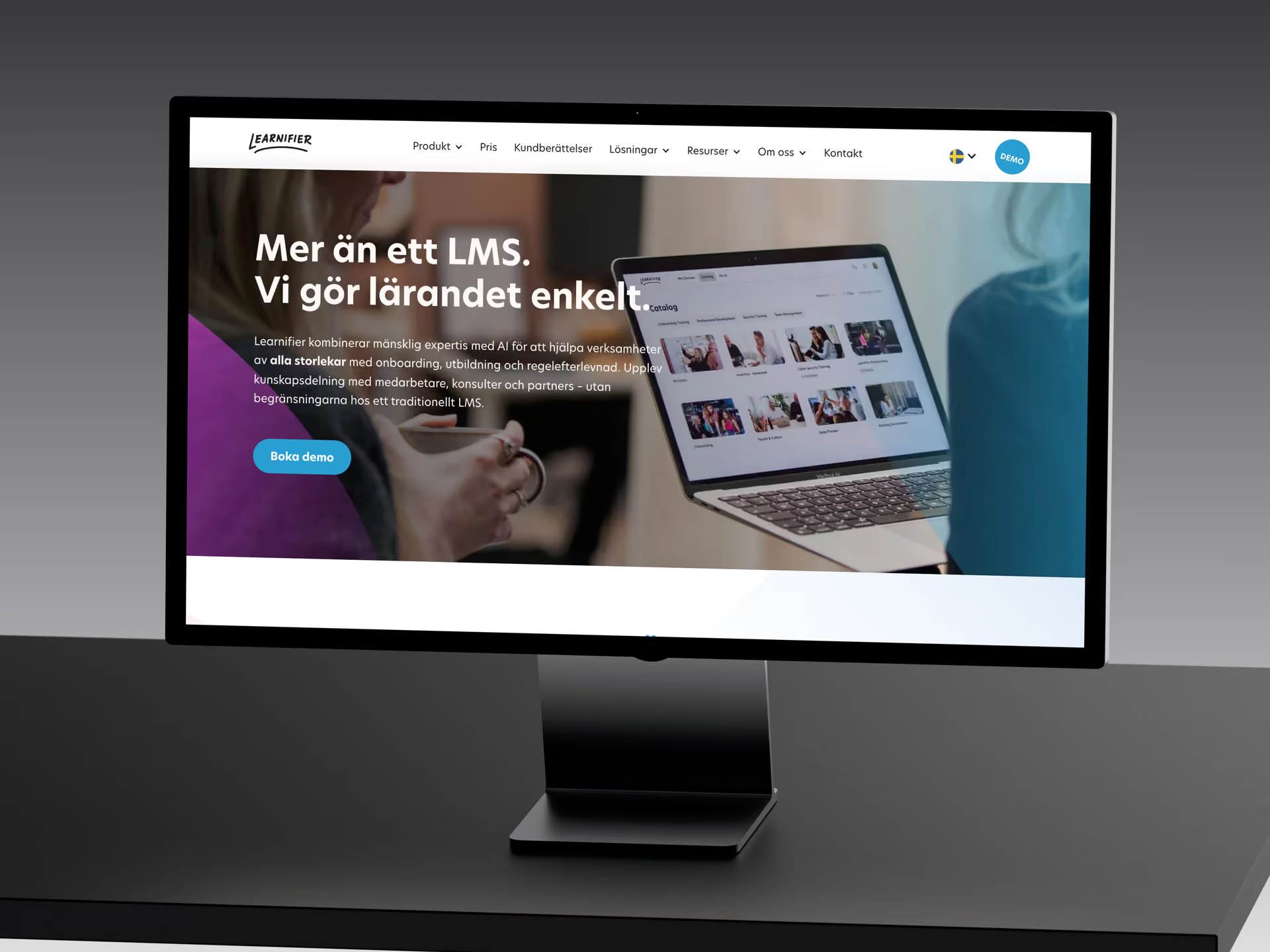
The choice of platform comes last and is based on your needs: often Webflow when the marketing team will run the website itself, a coded website with a headless CMS when performance, scalability or integrations matter more, and Shopify for e-commerce. The choice is yours – we make a recommendation. For Learnifier, the information architecture and the language structure were settled before the build. The website now runs in four languages from a single CMS, with ongoing SEO and AEO work.
When we look at an existing website, we sometimes conclude that it does not need to be rebuilt – what is missing is a structure that follows how buyers search, and clearer routes to contact. Then we say so, and the plan becomes a restructure on the existing platform instead of a new build.
Why a 90-day plan instead of an annual plan?
We normally write the plan for 90 days at a time, not for a year. A growing company changes its offer, staffing and budget more often than that, and an annual plan is effectively out of date after a quarter.
The direction stays stable: business goals, target audience and positioning do not change every quarter. The tactics do. A 90-day plan contains three to five prioritised initiatives, each with one owner – you or us – and the measurement point from the measurement plan that decides whether it succeeded. The work within each initiative is continuously reprioritised around what works. The plan must never contain more than the team can handle alongside everything else.
At the end of the quarter we review three things: what worked, what to stop and what to prioritise next. Initiatives that worked get more room. Initiatives that delivered nothing after an honest attempt are dropped, without anyone having to defend an annual document. The time frame also fits how the channels behave: technical SEO fixes and advertising show results within a quarter, while new content and AI visibility often need two.
How long does the strategy work take?
Getting from the discovery call to an approved plan usually takes a few weeks, depending on how quickly we get access to search data, analytics tools and the people on your side who deal with customers. The workshop takes half a day. If we carry out the plan, work starts straight after approval, and the first quarterly review takes place 90 days later. If you need a plan sooner – ahead of a launch or a funding round – tell us on the first call.
Do you carry out the strategy yourselves?
Yes, happily. The same team that draws up the plan builds the website, runs SEO and AEO, manages Google Ads and produces the content – as your outsourced marketing department or as an extension of your own team. Anything you do yourselves, such as LinkedIn posts in management's name or customer quotes for new case studies, is set out in the plan as your responsibility. If you only want the strategy and will carry it out with your own resources, that works just as well – the plan is then written for your team. It can be a one-off piece of work that points you in the right direction, and if you want a progress review or targeted help later on, we are still here.
What comes on top of the workshop and the plan?
Whatever you choose to have us carry out. Website, SEO, AEO, advertising and content are priced per initiative or as an ongoing partnership with no lock-in period, and you decide from the plan what to start. Ad budgets and licences in your name, such as the website platform or your CRM, are paid directly to the supplier. The tools we use ourselves are included in our fee. If you only want the workshop and the plan, and will carry it out yourselves, there is nothing extra to pay.
Why do strategies end up on the shelf – and what is the downside of your approach?
Strategies that end up on the shelf rarely fail because of the analysis. They fail because nobody owns the step after the document. The agency that wrote the plan hands it over, the marketing team has to buy in and coordinate the work, and three months later the material is out of date. When the people who write the strategy also carry it out, there is no handover. The recommendations are realistically costed, because we know what they cost to build. The plan is corrected when reality turns out differently, instead of standing unchanged until the next strategy project.
The approach has a downside that should be stated plainly: an agency that carries out the work itself has an interest in recommending its own services. We handle that in two ways. We write down what we rule out and why, and we work without a lock-in period. If an initiative is not working, you should be able to end it without being tied to a contract.
Who is a strategy-led web agency right for – and when is a strategy consultant or a full-service agency a better choice?
Our approach – a digital strategy agency that also carries out the strategy – suits companies that want both the strategy and the execution from the same agency, whether marketing sits with one or two people or you want to hand the entire execution to us. If you have your own team doing the work, you can buy just the strategy from us, or bring us in where the team lacks capacity. If you want everything from PR to events and film from a single agency, an agency with that breadth is a better choice.
Three alternatives, three different situations. A digital strategy consultant delivers analysis and a plan but not the execution – a good fit when you have your own resources but lack direction. A full-service agency covers every channel and suits you when breadth matters more than depth in web and search. A strategic web agency – our approach – goes deep on website, search, AI visibility, advertising and content, and does the work itself. Breadth – PR, events, film – is not our focus.
How does it differ from a marketing strategy?
The marketing strategy is the business layer: who you sell to, what you offer, how you position yourselves and what you rule out. The digital strategy builds on it and decides how all that is turned into a website, search, AI visibility, advertising and content. If the business layer is unclear, we start there – otherwise we would be optimising channels for an unclear offer. The basics are covered in the guide to marketing strategy.
Do we need a new website to work with you?
No. We work with your existing website, and the strategy work decides whether it needs rebuilding at all. A new structure and clearer routes to contact are often enough. If the website sits on a platform with limitations – in structure, performance or extensibility – that can cap what the strategy can achieve. In that case we recommend a move and produce the brief for it as part of the plan.
WHERE ARE YOU – AND WHAT SHOULD BE DONE FIRST?
Book a free call, or request a quote directly. We go through your business goals, current website and channels, and tell you what we would prioritise over the next 90 days – and whether strategy work is the right investment for you right now.