

CRO — CONVERSION
CRO AGENCY – CONVERSION RATE OPTIMISATION
Conversion rate optimisation means turning more of the visitors you already have into customers. As a CRO agency, we look for friction where it usually hides – in the data, the user flows and the copy – and rebuild what needs rebuilding. Measured in extra deals, raising your conversion rate is often cheaper than buying more traffic.
MORE CUSTOMERS FROM THE TRAFFIC YOU ALREADY HAVE
Conversion rate optimisation (CRO) is about increasing the share of visitors who do what you want them to – buy, book or get in touch. Unlike an ordinary design tweak, the changes are based on data showing where visitors actually drop off, not on taste.
We cover the whole chain: analysing where the friction is, forming hypotheses about what causes it, making the changes on the website and checking whether they worked. If there is too little data at the start, we begin with well-founded hypotheses, set up tracking and let the data guide the work from there. What counts as a reasonable conversion rate varies widely between industries and traffic sources – we cover industry benchmarks in the guide to conversion rates. That is why we always establish a baseline before promising anything.
What's included
- Measurement and analysis
- Hypotheses and prioritisation
- Form and checkout flows
- Landing pages
- UX adjustments
- A/B tests or measurement against the baseline
~1,000
conversions a month in a flow before an A/B test can give an answer within four weeks
~400
conversions per variant to show a 20% improvement
0 months
minimum term on our ongoing agreements
Our process
FROM FRICTION TO MORE BUSINESS
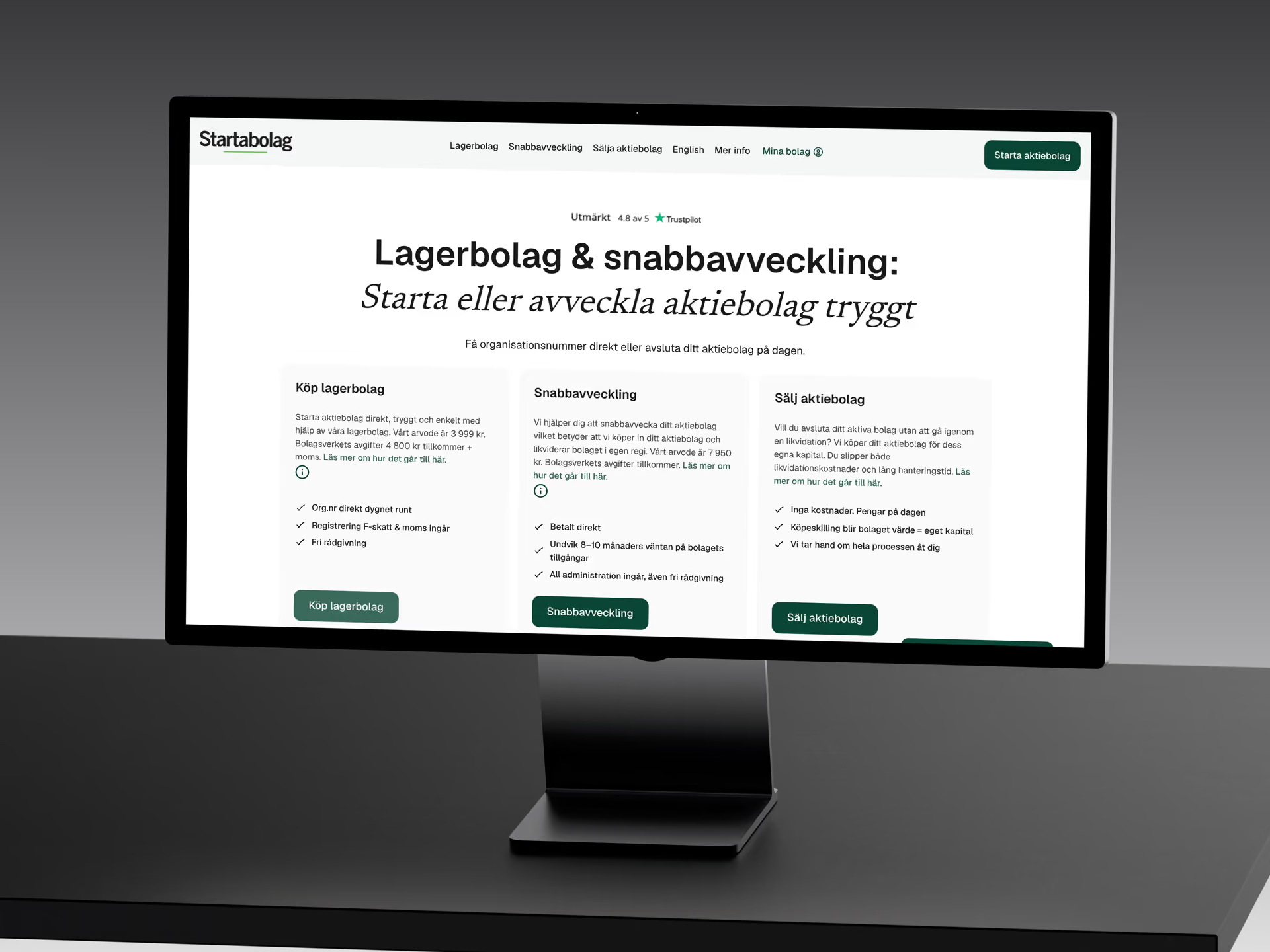
At Startabolag AB, we contacted SEOS Design in summer 2025 to update our website. There were some challenges in connecting the old database to the new website, but SEOS solved them smoothly and professionally. We are very happy with the new website. SEOS has also helped us increase our organic traffic and has optimised our search ads. We use SEOS on an ongoing basis to improve our visibility further. We warmly recommend SEOS to anyone who needs a new website or wants to strengthen their digital presence.
 Per Englund RydbergCo-founder, StartabolagTranslated from Swedish
Baseline and measurement
We start with what the data actually says: where in the flow visitors drop off, which pages lose the most and whether tracking is even set up correctly. Without a credible baseline, there is no way to tell whether later changes had any effect.
Analysing the friction
Quantitative data shows where the problem is, not why. We add session recordings, form analytics and a review of the offer and copy – and user testing when needed. The result is a list of concrete friction points, not a general opinion about the design.
Hypotheses and prioritisation
Every change is framed as a hypothesis with an expected effect, then prioritised by its potential business impact relative to the effort. We start with what makes the biggest difference – usually the offer, clarity and form flows rather than button colours.
Implementation, measurement and iteration
We rebuild what needs to change, directly in your platform. If you have the traffic volume for it, we validate with A/B tests. If you don't, we measure the effect against the baseline over time instead. Then the cycle starts again with the next friction point on the list.
One-off analysis or ongoing work – how you buy it
Fixed price on request
A one-off analysis with a prioritised action list is sold at a fixed price. When you send an enquiry, you get a price estimate without us needing to meet, and the fixed price before the work starts. The price depends on how many flows need analysing and whether tracking has to be fixed first. Ongoing work – analysis, implementation and follow-up in rounds – is usually part of an SEO or CRO agreement with no lock-in, where the plan is reprioritised based on what is working and there is room for anything else you want help with.
What conversion rate optimisation typically costs in Sweden, which pricing models are common and how to build the business case before you buy anything are all covered in the guide to what a CRO agency costs.
Selected projects


Common questions about conversion rate optimisation
What is the difference between conversion rate optimisation and UX design?
UX design is about making the experience understandable and usable. Conversion rate optimisation is about increasing the share of visitors who follow through. They often overlap – clearer UX generally raises conversion – but the starting point differs. CRO starts from data on where visitors drop off and prioritises changes by business value. Good conversion rate optimisation requires UX expertise, but not all UX work is conversion rate optimisation.
Where is the friction usually found on a B2B website?
Rarely in the button colours. On B2B websites, friction comes from what the website does not say and from what it asks of visitors too early. The same patterns recur in every industry.
- The form asks too much, too early. Company registration number, budget and phone number – before the visitor knows what happens once the form is sent. Fewer fields and a clear description of the next step often remove more friction than any design change.
- The offer is unclear. The homepage describes the company, not what the buyer gets, who it is for and what problem it solves. A visitor who has to read three pages to work out whether you are relevant rarely bothers.
- There is no pricing page. B2B buyers want to qualify themselves before getting in touch. "Request a quote" with no indication of price filters out everyone who doesn't have time to book a meeting just to get a figure. A starting price, a pricing model or a worked example is often enough.
- There are too few ways to get in touch. A form is the only way in – no phone number, no named contact and no way to book a call directly. Different buyers want to contact you in different ways.
- The proof is in the wrong place. Case studies and reviews exist, but on a separate page, far from the point where visitors hesitate.
We work on the whole journey from first visit to submitted form, not just a single landing page. On B2B websites with a long sales cycle, we also measure the steps in between – downloads, booked meetings, visits to the pricing page – because a single end goal gives too little data to steer by.
How does conversion rate optimisation work for e-commerce and online shops?
In an online shop, the conversion rate is decided in three places: the product page, the checkout and the delivery and returns information visitors look for before they decide to buy. That is why conversion rate optimisation for e-commerce is less about the homepage and more about the pages where the purchase actually happens.
On the product page, the job is to answer the questions customer service hears most often – fit, dimensions, delivery time, stock levels – on the page itself, not in an FAQ three clicks away. In the checkout, the usual problems are forced account creation, delivery costs that only appear at the last step, too many steps and missing payment methods. Delivery and returns terms should be visible where hesitation arises – in the basket and on the product page – not just in the footer.
Mobile performance matters here too. A slow online shop loses visitors before they have even seen the product, and Core Web Vitals affect both how the shop feels to use and how Google rates it.
If your shop runs on Shopify, we work directly in the theme and the checkout settings. We also help you choose the platform, theme and apps when the shop is being built or rebuilt – read more about how we work as a Shopify agency. How to bring organic search traffic to the shop is covered separately in the guide to SEO for e-commerce.
Why does conversion rate optimisation start with measurement – and why is the first deliverable often a GA4 fix?
The first thing we deliver in a CRO project is rarely a new page. It is tracking you can trust. Google Analytics often turns out to be miscounting the very things that matter most, and then there is nothing to optimise against.
The errors are usually mundane but decisive. The conversion is recorded when someone clicks the submit button rather than when the form is successfully sent, so spam and abandoned attempts count as leads. The booking tool sits on another domain and loses the session along the way. The consent banner is configured so that an unknown share of visitors never appears in the statistics. Forms submitted via JavaScript show no thank-you page, so tracking based on the thank-you page records no event at all.
That is why we usually start by reviewing events, key events and consent settings (Consent Mode v2) before drawing any conclusions. We recommend treating that review as part of the deliverable, not a detour: a conversion rate that is measured wrongly leads to the wrong priorities in everything that follows. If you would rather not use GA4 at all for privacy reasons, the same baseline can be built with one of the tools in our comparison of GDPR-friendly analytics tools.
How much traffic do you need to A/B test – and can you do conversion rate optimisation without testing?
As a rule of thumb, for an A/B test to detect a 20 per cent improvement, each variant needs around 400 conversions – more if the improvement is smaller. The test should also run for at least four full weeks. With two variants, that works out at roughly 1,000 conversions a month in the flow being tested – conversions, not visitors. If you have ten orders a month, a test never becomes reliable before conditions change. That does not make conversion rate optimisation the wrong investment. It means you need a different method.
With low traffic, we replace the test with qualitative methods that show why visitors hesitate, not just that they do:
- Session recordings and heatmaps, which show where visitors stop, scroll past or click on things that are not clickable.
- Form analytics, which show the field where people give up.
- User testing with a handful of people from your target audience, who carry out a concrete task on the website while we observe.
- Conversations with sales and customer service about which objections and questions keep coming up – they often already know what the website fails to explain.
- A structured review of the offer, flows and copy against established principles – the kind of review we describe in the guide to what a UX audit includes.
Unlike a test, this approach measures the effect against the baseline over time, allowing for seasonality and other changes, rather than in a controlled comparison. That is why we prioritise bigger changes – offer, page structure, form flow – over minor tweaks: without a test, small differences cannot be separated from the noise. If an improvement cannot be shown statistically, we report it as a trend, not as a certain result. We explain when conversion rate optimisation is not the right investment at all – for example when the website is going to be rebuilt anyway – in the section on when CRO is not worth it.
Why should analysis and implementation sit with the same team?
A common objection to CRO projects is that they end in a report nobody has time to implement. We recommend keeping analysis and implementation in the same team, and that is how we work: the people who analyse the friction also rebuild the website – in Webflow, Shopify or a coded website with a headless CMS – and follow up afterwards.
It matters for two reasons. The first is pace: an action list that has to be interpreted by another agency or an in-house developer with other priorities often sits untouched for months. The second is quality: whoever framed the hypothesis knows what can and cannot be changed when the change is built. Recommendations that get simplified in the handover often lose exactly what made them work.
Changes that have proved their worth are built permanently into your platform, not left as variants in a testing tool. You should be able to manage whatever we build yourselves afterwards, without waiting for a developer. Where that is not possible – structural changes to a coded website, for example – we say so in advance and help when needed.
Can you work with our existing website?
Yes – that is the usual starting point. Conversion rate optimisation is normally done on a website that already exists and already has traffic; that is the whole point. We work on most platforms, most often Webflow, Shopify and coded websites in Next.js.
In some cases, though, rebuilding is more economical. When technology, design and messaging are all lagging behind, every individual improvement is expensive and makes little difference. A new website on a modern foundation solves everything at once and makes further work more efficient. If the analysis shows that this is the case, we recommend a new website rather than optimising details on a foundation that will not hold.
Do you do conversion rate optimisation remotely and outside Stockholm?
We are based in Stockholm, and most of the work is done remotely. We work from data, recordings and your website. Reviews and check-ins happen over video. Your location affects neither the analysis nor the implementation.
What does need your time is knowledge of the business: margins, sales cycle and which leads actually become customers. We gather that at kick-off and in regular check-ins, wherever you are.
What determines the price of conversion rate optimisation?
Mainly three things: how many flows need analysing, whether tracking has to be fixed before the work can start, and whether you buy a fixed-scope analysis or ongoing work with implementation and follow-up. A one-off analysis is quoted at a fixed price after an initial call. Ongoing work is usually part of an agreement with no lock-in, where the plan is reprioritised based on what is working. We cover market prices and pricing models in Sweden in the guide to what a CRO agency costs.
How long does it take before we see results from conversion rate optimisation?
The first changes – a clearer offer, fewer form fields, faster pages – can have a measurable effect within a few weeks. A structured testing programme takes longer, because each change needs enough data before the result can be trusted. Expect two to three months before you see a meaningful trend, and treat conversion rate optimisation as ongoing work rather than a one-off project.
MORE BUSINESS FROM THE SAME TRAFFIC?
Book a free call. We will go through your current conversion rate and where the friction probably lies, and give you an initial view on whether a one-off analysis or ongoing work suits you best – or whether something else should be in place first.