

LANDING PAGES — CAMPAIGNS & ADS
LANDING PAGES THAT CONVERT
As a landing page agency, we build landing pages for Google Ads, campaigns, launches and lead magnets – one page, one message, one goal. We build the page in your existing platform and test the tracking before any traffic is switched on, and the first page becomes the template your marketing team uses for the next campaign page. You get a fixed price per page before anything is built, and a lower price per page when you order a series.
ONE PAGE, ONE MESSAGE, ONE GOAL
A landing page is the part of the website that has to do one single thing: receive a visitor who has already shown what they want – through a search, a click in an email or a post – and lead them to the next step without detours. That is a different job from the homepage's, so the page is built differently: no menu, one form, and proof placed where the visitor hesitates.
Landing pages are part of our web development, but are usually bought as a defined piece of work: one page for a campaign, a series of pages for an ad account, a lead magnet page for a newsletter. We write the copy, build the page in your platform, connect the form to your system and set up tracking – and build the page so that it can serve as the template for the next one.
What is included
- Copy
- Structure in your platform
- Form connected to your CRM
- Thank-you page
- Conversion tracking
- Test conversion
- Template for the next page
2 weeks
for a simple landing page, from brief to publication
1 of 3
parts of the Google Ads Quality Score – one is the landing page
0 months
lock-in period – every page is a self-contained delivery
Our process
FROM BRIEF TO A PAGE YOU CAN MEASURE
We weren't looking for an agency that would just deliver a website – we were looking for a digital partner. SEOS Design built the website, set the tone of voice and now runs all of our SEM work. Having everything in one place, with a skilled and innovative team that owns the whole picture, has made an enormous difference to pace and quality. We couldn't be happier!
 Emil GlenngårdFounder, TillväxtstödTranslated from Swedish
Brief: offer, audience, traffic source
We go through what the page should offer, who it is written for, where the traffic comes from and which action counts as a conversion. This is also where we decide what type of landing page it is and whether it should be indexed – that shapes everything we build afterwards.
Copy, structure and form
We write the headline, offer and proof so that the page says the same thing as the ad or email that leads there, and design the form with the fields needed to qualify the lead – no more. You approve the copy before the build starts.
Build in your platform, as a template
The page is built in Webflow, your coded website or your Shopify theme, with interchangeable sections so that the next page is a copy with new content. The form is connected to your CRM or email tool, and the page is checked against Core Web Vitals on mobile.
Tracking, traffic and follow-up
We set up the conversion event, check it with a test conversion and pass it on to the ad platform. Only then is the traffic switched on. We track the conversion rate per source and propose the next change – or the next page in the series.
How much does a landing page cost?
Fixed price per page – before anything is built
A single landing page is quoted at a fixed price after an enquiry describing what you need, or a free call. The price depends on whether the copy is written from scratch or reworked from your material, how the form is to be connected to your systems, whether a design exists and which platform the page is built in. You know what is included before the work starts.
If you are going to run several campaigns, the price per page is lower when you order a series: the template is built once, and the following pages reuse the structure, sections and tracking. How a landing page compares with the cost of the whole website over time is in the calculator for what a website costs to build and own – and if you are paying for the traffic, the landing page's conversion rate is one of the variables in the break-even calculator for Google Ads.
Selected projects


Common questions about ordering a landing page
Why is the homepage not good enough as a destination for ads?
A landing page has one job: to get the person who came from a particular ad, email or campaign to do a particular thing. The homepage has the opposite job – helping anyone at all find their way on – and so rarely works as a destination for paid traffic. Someone who clicks on an offer wants to see exactly that offer, not a menu. In Google Ads, the landing page experience is also one of the three components of the Quality Score, and landing page quality affects both the ad's position and the cost per click; more on that on the page about our Google Ads agency.
This is how we build: the headline matches the ad, there is a single form, and the proof sits where the buyer hesitates – at the price, at the form, at the promise of delivery time. That is what separates a well-crafted landing page from a quick campaign page.
What types of landing page do you build – and how do they differ?
We build three types: landing pages for Google Ads and other paid traffic, campaign and launch pages, and lead magnet pages. They are built differently, because the traffic comes from different places and visitors are at different stages of a decision.
- Ads landing page. Built for one search and one ad group. The headline mirrors the keyword, the page has no navigation leading away and it loads quickly on mobile. It lives as long as the campaign does and is usually not indexed.
- Campaign or launch page. The traffic comes from several channels – email, social media, PR – and the visitor often already knows you. The page can say more, has an end date or an event, and a goal that suits the stage: registration, pre-order, demo.
- Lead magnet page. Exchanges content – a guide, a template, a webinar – for contact details. The result depends on how few fields the form has and on what happens after submission: the thank-you page, the delivery and the next step in your follow-up.
The type determines the copy, the form and the tracking. That is why we start with the traffic source, not with the design.
A landing page for a service company or an online shop – what is the difference?
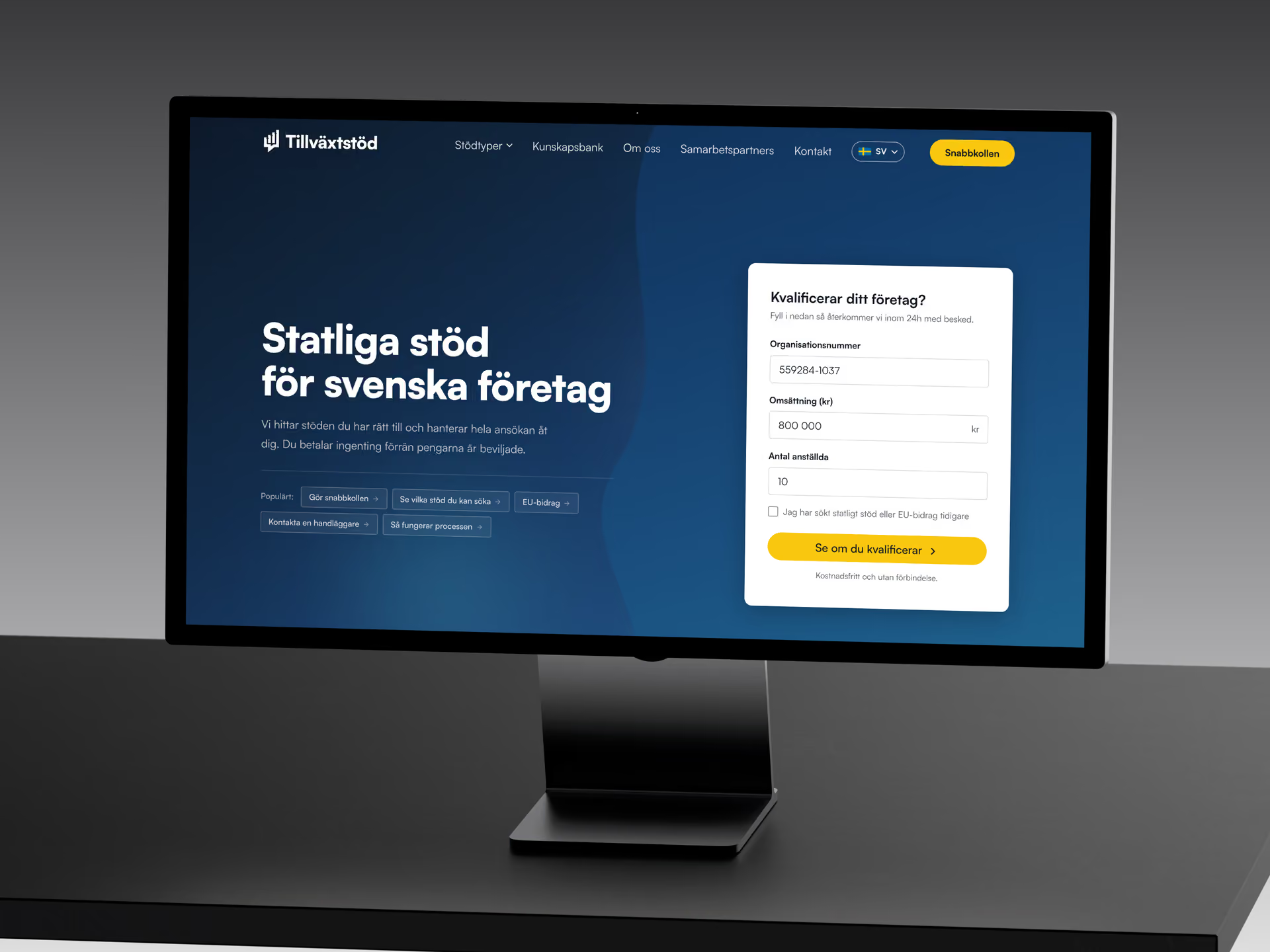
For a service company the goal is almost always a contact: a booked meeting, a quote request, a call. The hardest step is getting the visitor to hand over their details to a company they do not know. That is why we build qualification into the form – the right questions in the right order, in steps if there are many – a clear description of what happens after submission, and proof close to the form. For Tillväxtstöd we built multi-step forms connected to Salesforce with real-time validation of the Swedish company registration number, so that qualified leads land directly in the sales team's system – and we also run the advertising that fills the form.
For an online shop the goal is a purchase, and the landing page is more often a campaign page that leads on to product pages. In that case, the offer, the shipping terms and the route to checkout must be visible straight away. We build campaign pages for a Shopify store in the theme, so that they follow the store's design and can be reused. How we work on conversion across the whole website is described under conversion rate optimisation.
Landing pages and SEO – should the page be indexed?
It depends on how long the page is meant to live. We normally set an Ads landing page for a time-limited campaign to noindex: it is written for an ad, not for a search, and otherwise risks competing with your regular service page for the same keyword.
A landing page meant to live for a long time – a service for a segment, a location or a use case – is built as an SEO landing page: its own search intent, its own metadata, content that answers the question instead of repeating the ad, and a canonical tag that points to the page itself. Pages like that bring organic traffic to the same offer as the ads. The page you are reading is built that way. If we build several for the same service, each page gets its own content and its own question – otherwise they become thin copies that neither Google nor an AI assistant has any reason to surface.
Can the landing page be built in our platform?
We recommend building the landing page in the platform you already have – Webflow, a coded website with a headless CMS or Shopify – instead of in a separate landing page tool. Then the page inherits your design, domain, tracking and consent management, and you avoid yet another licence. We build in Webflow, in coded websites with a headless CMS such as Sanity or Contentful, and in Shopify themes. If your website is on Wix or Squarespace, we tell you what is possible there and suggest a way to build the page without you rebuilding everything.
Are copy and forms included in a landing page?
Yes. We write the headline, offer, proof and form copy from your material, or rework copy you already have. The form is built with the fields needed to qualify the enquiry, connected to your CRM – for example HubSpot or Salesforce – or your email tool, and gets a thank-you page and a conversion event. Multi-step forms or validation against registers, like the ones we built for Tillväxtstöd, are quoted as a separate item.
Can we build more landing pages ourselves afterwards?
Yes, if the first one is built as a template – and that is how we build. The first landing page gets interchangeable sections, fields for the headline, offer, proof and form, and a structure where a new campaign page is a copy with new content – not a new project. Every new page inherits what worked on the previous one, and what the data shows is built into the template.
In Webflow the template becomes components in the editor, as in our Webflow development: you copy the page and change the headline, offer, proof and form without touching the design. On a coded website it becomes a page type in the CMS, and you create a new page of that type; changing the structure itself requires code, and we help when needed. If you want to put together completely new types of pages from ready-made sections, an extended page builder package is available as an add-on.
Is it cheaper per page if we order several landing pages?
Yes. The template – structure, sections and tracking – is built once, and the following pages in the same campaign series reuse it. That is why the second page onwards costs less than the first. The quote, which you get after an enquiry or a free call, sets out what is included and what each page costs.
How quickly can a landing page be ready?
A simple landing page can be ready in two weeks, compared with the usual 4–6 weeks for a full website. What sets the pace is the material: a decided offer, images and proof that already exist, and someone who can approve the copy without long delays. If we build on a template that already exists in your platform, it goes faster. The delivery date is stated in the quote, so you can plan the campaign launch around it.
Which metrics decide whether a landing page works?
The page is measured on its own, against its own goal, and the tracking is set up and tested before the first visitor arrives. A campaign without working conversion tracking cannot be evaluated – and the money spent on traffic is wasted.
In practice, a submitted form, booking or purchase is recorded as an event in Google Analytics, the event is passed on to the ad platform and we run a test conversion before the campaign starts. We then track the conversion rate per page and traffic source – and, for advertising, the cost per enquiry – so that you can see whether it is the ad, the page or the offer that falls short; industry benchmarks are in the guide to conversion rate. We use A/B testing when there is enough traffic for a reliable answer. Otherwise we change one thing at a time and measure against the baseline.
Before we build, four things need to be decided:
- The offer – what the visitor gets and what it costs or requires
- The audience – who the page is written for and what they already know
- The traffic source – Google Ads, email, social media or several
- The tracking – which event counts as a conversion and where it should show up
The same checklist, applied to a first campaign, is in the checklist before a first Google Ads campaign.
ONE PAGE, ONE GOAL – SHALL WE BUILD IT?
Request a quote, telling us what you already know about the offer and the traffic source, or book a free call. We go through what the page should offer, where the traffic comes from and what should count as a conversion – and you get an assessment of whether a landing page is the right move, or whether something else should be in place first.